
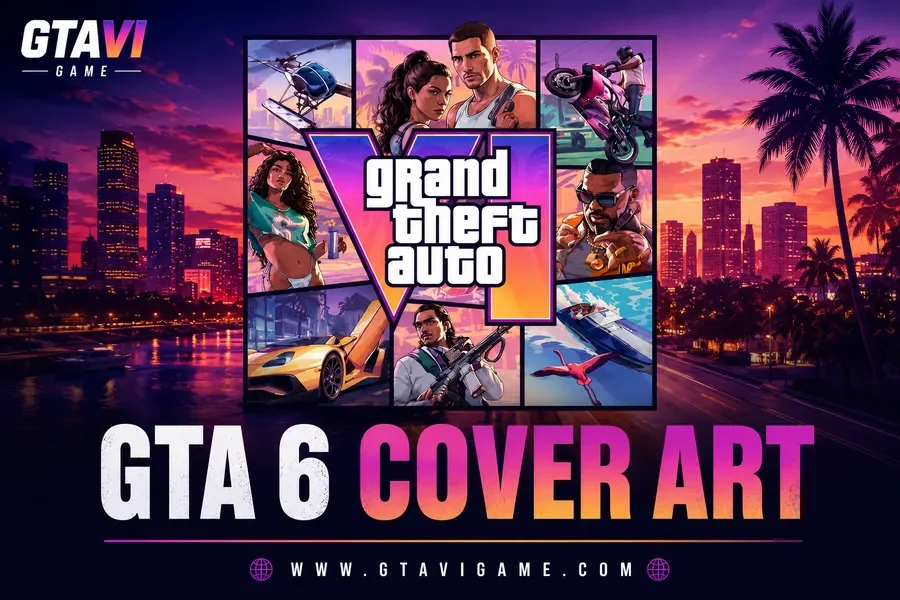
GTA 6 Cover Art Reveal: Details & Easter Eggs
The reveal of the official GTA 6 cover art marks a major milestone in the game’s marketing campaign. Rockstar Games continues its tradition of using hand-painted grid designs to represent the atmosphere of Vice City. This analysis breaks down the design elements, symbols, and artistic style of the game’s box art.
- •Cover Style: Nine-panel grid layout (maintaining GTA series tradition).
- •Protagonists: Lucia and Jason are featured in central panels.
- •Key Elements: The top-left panel features the signature helicopter, a staple since GTA 3.
- •Authority Source: Rockstar Games official key art design guidelines and promotional archives.
The History of the Iconic GTA Grid Layout
Rockstar Games has used a consistent template for its box art for over two decades. Starting with Grand Theft Auto III in 2001, the series adopted a 3×3 grid layout of hand-painted panels. This design choice replaced the generic collage designs used in early entries, establishing a visual identity for the franchise.
Each panel in the grid represents a different aspect of the game’s world. One panel always features a helicopter in the top-left corner, a detail that has appeared on every cover since GTA 3. Other panels display protagonists, high-performance vehicles, secondary characters, and local wildlife, giving players a visual summary of the experience.
According to Rockstar Games official key art design guidelines and promotional archives, the hand-painted style is created by the studio’s internal illustration team. The process involves taking real photos of actors and vehicles, drawing vector outlines over them, and layering digital paint to create a high-contrast comic-book-inspired aesthetic.
For details on the confirmed release date and platform launch schedules, visit our GTA 6 release date guide.
Lucia and Jason: A Cinematic Composition
The central panels of the GTA 6 cover feature the two protagonists, Lucia and Jason. The composition is inspired by classic crime films, with the characters positioned back-to-back or leaning against a sports car. This visual styling emphasizes their cooperative relationship and Bonnie and Clyde narrative theme.
Lucia’s position on the cover represents a milestone for the series. She is the first female protagonist to appear on a GTA cover since the 2D era of the late 1990s. Her character panel shows her holding a compact submachine gun with a sunset background, reflecting her role as a key player in the story.
Jason’s panel is positioned opposite Lucia’s, showing him looking over his shoulder. His panel features a cooler blue and purple color scheme, contrasting with the warm pinks and oranges of Lucia’s panel. This color division represents their differing personalities and background stories.
To see how these characters translate into gameplay, see our analysis of GTA 6 new features and gameplay mechanics.
Panel-by-Panel Symbolism Breakdown
Analyzing the individual panels reveals several details about the game’s setting and mechanics. The grid contains nine panels, each designed to highlight a different aspect of the state of Leonida:
| Grid Position | Visual Element | Symbolic Meaning |
|---|---|---|
| Top-Left | Police Helicopter | Signature series element; active wanted system |
| Top-Center | Lucia (Profile) | Focus on the female protagonist and story |
| Top-Right | High-end Sports Car | Vehicle customization and high-speed driving |
| Middle-Left | Leonida Wildlife (Alligator) | wetlands and diverse ecosystems |
| Middle-Right | Neon Palms / Vice City Streets | Setting atmosphere and tropical environment |
| Bottom-Left | Jason (Profile) | Focus on the male protagonist and combat |
| Bottom-Right | Coastline Speedboat | Water physics engine and coastal travel |
The inclusion of an alligator panel highlights the game’s focus on Leonida’s ecosystems. Moving beyond urban Vice City, the map includes significant rural and swamp regions, which are highlighted on the cover to prepare players for the geographical variety of the map.
If you want to read about why the release dates might change or check the history of Rockstar’s schedule shifts, see our GTA 6 delay history timeline.
Color Palette and Branding
The color scheme of the cover art is dominated by Vice City’s signature colors: violet, magenta, orange, and yellow. These colors match the official GTA 6 logo gradient, creating a cohesive visual brand across all promotional materials.
The use of high-saturation gradients is designed to stand out on retail shelves and digital storefronts. While competitors often use dark, desaturated covers for crime games, Rockstar uses bright tropical colors to create a unique look, reflecting the neon atmosphere of the setting.
For information on pre-orders and securing physical editions featuring this artwork, see our GTA 6 pre-order guide.
This visual styling will also be used for the game’s physical disc art and steelbook packages. Collectors can expect limited-edition boxes that feature alternative art styles, providing a premium package for physical media collectors.
The cover art maintains the series’ traditional 3×3 grid layout and features the signature top-left helicopter. Lucia is the first female protagonist on a modern GTA cover. The artwork uses Vice City’s sunset colors.
Frequently Asked Questions
What does the cover art look like?
It features a nine-panel grid design with hand-painted illustrations of characters, vehicles, and settings from Vice City.
Is there a helicopter on the cover?
Yes, the signature police helicopter appears in the top-left panel, maintaining a tradition started in 2001.
Who is the girl on the cover?
The female character is Lucia, one of the two playable protagonists in the game’s story mode.
Is the artwork different for PS5 and Xbox?
No, the core artwork is identical on both consoles, with only the top branding headers changing to match the platform.
Who designs the GTA covers?
The covers are designed by Rockstar Games’ internal marketing and illustration team, using digital vector painting methods.